

Key Takeaways
- Vacuum excavation offers a non-destructive method for exposing underground utilities, significantly reducing the risk of damage.
- This technique enhances worker safety by minimizing direct contact with hazardous underground infrastructure.
- Adoption of vacuum excavation can lead to cost savings by preventing utility strikes and reducing project delays.
- Environmental benefits include reduced soil displacement and minimized disruption to surrounding areas.
Understanding Vacuum Excavation
The evolution of excavation techniques in construction has led to the increasing adoption of vacuum excavation, an innovative, non-destructive method for exposing underground utilities. Unlike traditional digging methods that often rely on heavy machinery and manual labor, vacuum excavation uses high-powered suction to carefully remove soil and debris, minimizing the risk of utility strikes and preserving existing infrastructure. As the need for safer, more precise excavation grows, professionals are turning to specialized tools, such as a vac trailer, for reliable, efficient results, especially in sensitive or urban environments.
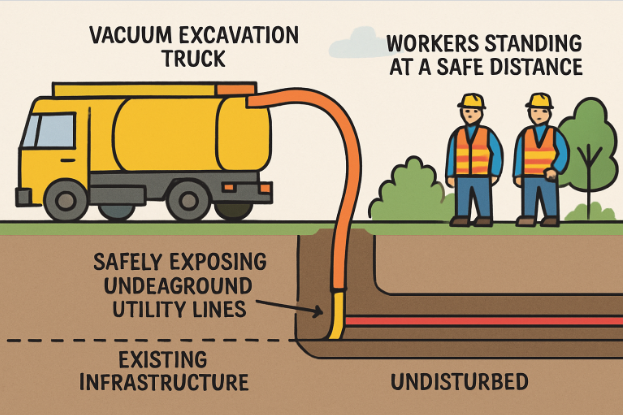
Vacuum excavation uses a vacuum system to combine pressurized air or water with soil, breaking it up before safely removing it. The loosened material is then transferred to a holding tank, leaving utilities exposed without causing physical harm. This process—also called hydro excavation (when water is used) or air excavation—has become especially valuable as the complexity and density of underground infrastructure have increased in cities and developed areas. The use of these advanced technologies not only advances traditional excavation safety standards but also aligns with evolving construction industry needs.
Enhancing Safety on Construction Sites
Worker safety remains a paramount concern on construction sites, particularly when dealing with buried utilities. The risk of costly, dangerous utility strikes is ever-present with conventional digging equipment. Vacuum excavation provides a much safer alternative by enabling crews to uncover utilities with surgical precision, reducing the likelihood of accidental damage to gas, electric, water, or fiber-optic lines. This approach aligns with OSHA guidance on excavation safety, which emphasizes protective measures and careful planning to prevent accidents and injuries.
In addition to mitigating direct contact with hazardous utilities, vacuum excavation reduces manual labor in hazardous areas, decreasing the chance of on-site injuries. The controlled application of air or water eliminates the forceful and sometimes uncontrollable digging associated with mechanical methods. As a result, job sites enjoy a safer environment and fewer unexpected emergencies, further reinforcing the value of this efficient approach.
Cost Efficiency and Project Timelines
The financial benefits of vacuum excavation extend well beyond reduced repair bills from fewer utility hits. Unlike traditional digging, which can unearth uncertainty about utility locations and prolong projects, vacuum excavation streamlines the process with speed and minimal disruption. Construction teams can locate and daylight utilities faster, gaining the benefit of real-time accuracy that reduces unnecessary excavation.
Environmental Considerations
With sustainability gaining attention in the construction industry, vacuum excavation is recognized for its positive environmental impact. Because it disturbs only the necessary amount of soil, the technique preserves native earth structure and prevents widespread ecological disruption. There is less dust and debris generated, minimizing airborne particles and protecting water bodies from runoff and sedimentation. These qualities make vacuum excavation an ideal choice for projects in environmentally sensitive zones, urban areas with close neighbors, and public works projects destined for green certification.
Applications in Various Construction Projects
The adaptability and precision of vacuum excavation make it valuable in a wide range of construction activities. Emergency repairs, potholing, test hole drilling, and daylighting utilities for directional drilling or boring are just a few examples. According to Trenchless Technology, the North American vacuum excavation market is evolving rapidly, reflecting the technology’s growing role in improving safety and efficiency on construction sites. In old neighborhoods or on congested city streets where infrastructure maps may not be reliable, vacuum excavation allows crews to confirm utility layouts before proceeding, adding a layer of certainty and reducing risks on complex projects. This versatility ensures its importance in both everyday construction and challenging, urgent, or high-profile repairs.
Challenges and Considerations
Despite its apparent benefits, vacuum excavation poses challenges that have slowed its widespread adoption. The initial cost of equipment can be higher than that of traditional digging machinery, and there remains industry inertia due to unfamiliarity with the method. Education and demonstration of long-term cost savings and improved safety outcomes are essential for broader acceptance. As the industry shifts towards prioritizing worker safety, efficiency, and sustainability, the rise in demand and awareness will likely make vacuum excavation the standard across more regions.
Conclusion
Vacuum excavation marks a turning point in construction safety, efficiency, and environmental protection. As contractors seek to cut costs, improve safety, and ensure compliance with rigorous regulations, this method provides a forward-thinking solution to the hazards of traditional excavation. As underground utility networks become increasingly complex, vacuum excavation offers a solution that not only protects infrastructure and workers but also supports sustainable, modern construction practices.
